# Architecture
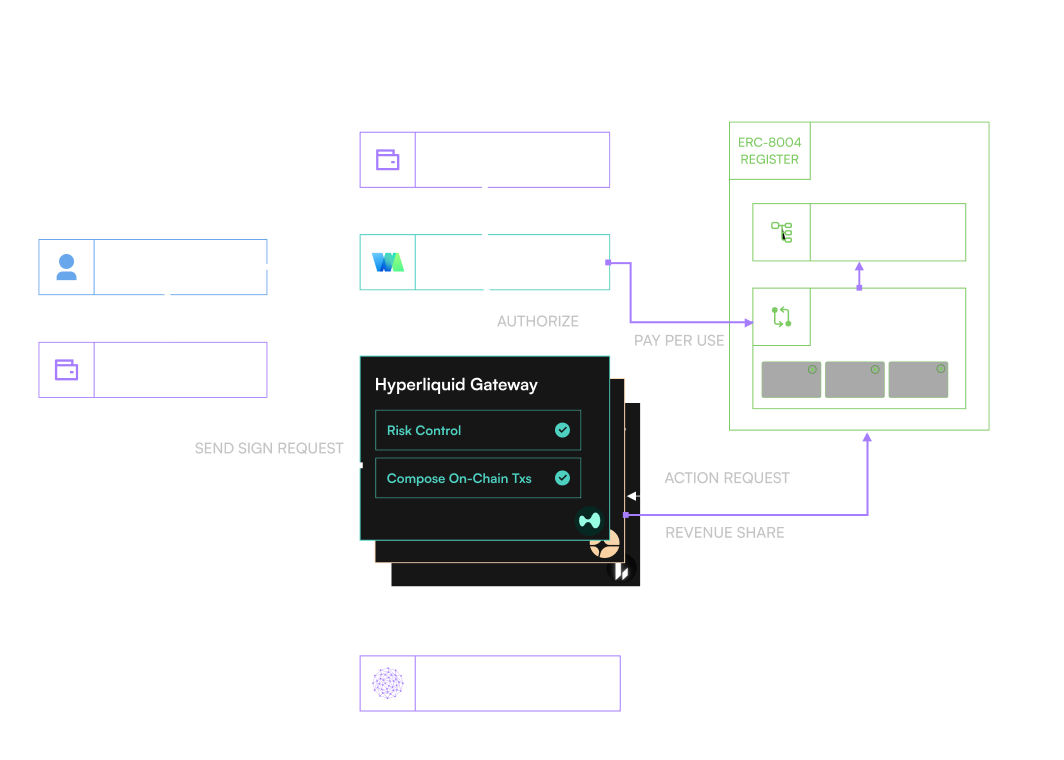
## Three-Layer Architecture
" %}
# Tokenomics
### Revenue Model and Token Economics
Wildmeta operates a comprehensive token economy centered around the $WILD token, designed to create sustainable value while incentivizing ecosystem participation. The trade-to-earn mechanism rewards active users with points that convert into $WILD airdrops during distribution events.
The platform charges execution fees via the x402 protocol, creating revenue streams that directly support ecosystem development. Protocol revenue gets used to buy back $WILD tokens from the market, creating deflationary pressure that benefits token holders while ensuring sustainable platform funding.
#### Trading Fee Buy backPhilosophy
Unlike traditional platforms that extract value through trading fees, Wildmeta will use all earned trading fee to buy back the $WILD token. Revenue generation focuses on financial services including AI bot deployment, and cross-chain swapping services.
The strategy creates a competitive advantage by removing friction from trading while building sustainable revenue through services that add genuine value to the trading experience.
# Roadmap
#### Near-Term Objectives
The immediate focus involves expanding the x402 marketplace with additional data providers and trading bots available as skills. This expansion increases the variety and sophistication of tools available to users while creating more opportunities for ecosystem participants.
#### Platform Evolution
Development plans include connecting to additional LLM providers and more DEX gateways, expanding the platform's capabilities and reducing dependency on any single infrastructure provider. This diversification improves reliability while providing users with more options for their trading strategies.
#### Advanced Integration
The roadmap includes integrating agent-as-skills marketplace functionality and connecting with the A2A (Agent-to-Agent) protocol. This advancement enables more sophisticated autonomous trading scenarios where multiple AI agents can collaborate on complex strategies.
# Account Abstraction
Wildmeta leverages Heima's advanced account abstraction technology to deliver the convenience of centralized exchanges while maintaining the security and ownership principles of decentralized finance through ERC4337 implementation.
### ERC4337 Implementation
The platform utilizes ERC4337 account abstraction wallets as the foundation for enhanced user experience without compromising non-custodial principles. This approach enables sophisticated wallet functionality including programmable transaction logic, gas abstraction, and automated execution capabilities.
Account abstraction eliminates traditional private key management complexity while preserving user ownership and control. Users interact with intuitive interfaces while the underlying infrastructure handles complex blockchain operations including multi-signature schemes, social recovery, and automated transaction batching.
Smart contract wallets generated through ERC4337 provide enhanced security features compared to traditional externally owned accounts. Multi-signature capabilities, time locks, and spending limits create comprehensive protection against unauthorized access while maintaining usability for daily trading operations.
### Delegation and Authorization
Heima's account abstraction enables granular delegation of specific capabilities to Wildmeta for on-chain interactions on behalf of users. This delegation model maintains user sovereignty while enabling seamless autonomous trading operations without repeated authorization friction.
Authorization scopes define precisely which operations Wildmeta can perform, including trading actions, asset transfers, and protocol interactions. Users maintain complete control over delegation parameters, enabling customization based on risk tolerance and usage patterns.
Revocable permissions ensure users can withdraw authorizations at any time, providing security confidence while enabling convenient autonomous functionality. Time-limited delegations offer additional protection by automatically expiring permissions after specified periods.
### Derivation Architecture
The system generates multiple specialized wallet types from a single user account through deterministic derivation. This architecture provides functional separation while maintaining unified control and simplified key management for users.
**Trading Wallet** serves as the primary interface for manual and automated trading operations, supporting USDC on Hyperliquid's HyperCore Network. This specialization ensures optimal performance for high-frequency trading activities while maintaining clear separation from other wallet functions.
**Agent Wallet** operates as a dedicated payment mechanism for x402 transactions, utilizing USDC on Base Network for efficient skill and data provider payments. This separation ensures transparent cost tracking while preventing interference with trading capital allocation.
**Funding Wallet** functions as the central hub for external interactions, supporting deposits and withdrawals across multiple chains and asset types. This wallet provides the primary interface between Wildmeta and external DeFi protocols, exchanges, and traditional financial systems.
### Security Framework
Trusted Execution Environment (TEE) and Secure Multi-Party Computation (SMPC) clusters provide institutional-grade security for key generation and management. These technologies ensure private keys remain protected even from Wildmeta infrastructure while enabling convenient user access.
Key exportability maintains user sovereignty by ensuring complete ownership portability. Users can extract their private keys and migrate to different platforms without losing access to their assets or trading history.
Hardware security modules and distributed key generation prevent single points of failure while maintaining performance requirements for active trading operations. Redundant security measures ensure continued access even during infrastructure maintenance or unexpected outages.
### Cross-Chain Capabilities
Multi-chain support enables seamless interaction with different blockchain networks without requiring users to manage multiple wallet applications or private key sets. The account abstraction layer handles cross-chain complexity while presenting unified interfaces to users.
Automated asset bridging reduces friction for cross-chain trading strategies while maintaining user control over bridge selection and associated risks. Users can configure preferences for different bridge providers based on security, speed, and cost considerations.
Chain-specific optimizations ensure optimal performance on each supported network while maintaining consistent user experience across different blockchain environments. Gas optimization and transaction batching reduce costs while improving execution speed for time-sensitive operations.
# Non-custody architecture
Wildmeta maintains a strict non-custodial approach, ensuring users retain complete ownership and control over their assets while benefiting from sophisticated trading infrastructure and autonomous capabilities.
### Ownership Principles
Wildmeta never takes custody of user assets under any circumstances. All wallet generation, key management, and asset control remain under user ownership through cryptographically secure mechanisms that prevent platform access to private keys or unauthorized asset movements.
User private keys are generated and stored using a combination of Trusted Execution Environment (TEE) and Secure Multi-Party Computation (SMPC) technologies. These approaches ensure that even Wildmeta infrastructure cannot access user credentials while maintaining the convenience of automated trading operations.
Asset control remains exclusively with users through smart contract design and cryptographic verification. All trading operations, transfers, and protocol interactions require user authorization through secure signature schemes that cannot be replicated or bypassed by platform infrastructure.
### Direct Wallet Connection
Experienced DeFi users can connect existing wallets directly to Wildmeta, maintaining their preferred security setup while accessing advanced trading capabilities. This connection method preserves existing security practices and wallet configurations without requiring migration or key sharing.
Direct wallet connection enables immediate access to advanced features including perpetual trading, automated strategies, and cross-chain operations. Users maintain complete control over their existing security practices while benefiting from Wildmeta's sophisticated trading infrastructure.
Integration supports all major wallet types including hardware wallets, multisig setups, and other sophisticated security configurations. The platform adapts to user preferences rather than requiring standardized security approaches that might compromise existing practices.
### Social Authentication Security
Social login options including email, Apple ID, and Google authentication provide convenience without compromising security principles. These methods trigger secure wallet generation processes rather than creating custodial relationships.
Email verification serves as the primary authentication mechanism, requiring only verification codes without registration processes or personal information collection. This approach minimizes privacy exposure while enabling secure account recovery and access management.
Generated wallets through social authentication utilize the same security infrastructure as directly connected wallets, ensuring equivalent protection regardless of authentication method. Users receive identical ownership guarantees and control capabilities across all authentication approaches.
### Key Exportability
All generated private keys remain fully exportable, ensuring users can migrate to different platforms or security solutions without losing asset access. This portability guarantee prevents vendor lock-in while encouraging user confidence in the platform.
Export processes provide multiple format options including standard private key formats, mnemonic phrases, and hardware wallet compatible exports. Users can choose formats that align with their preferred security practices and backup procedures.
Detailed export instructions and security recommendations help users transition safely while maintaining best practices for private key management. The platform provides educational resources without mandating specific security approaches.
### Audit and Verification
Smart contract architecture enables independent verification of non-custodial claims through open-source code review and formal auditing processes. Users and security researchers can examine contract logic to confirm the impossibility of unauthorized asset access.
Cryptographic proofs demonstrate the separation between platform functionality and asset control, providing mathematical guarantees rather than relying solely on policy commitments. These proofs enable trustless verification of security claims.
Regular security audits by independent firms provide additional assurance of continued non-custodial operation. Audit reports and findings are published transparently to maintain community confidence and accountability.
# Agent Wallet
The agent wallet serves as a specialized payment mechanism for autonomous x402 transactions, enabling seamless skill and data provider payments while maintaining clear separation from trading capital and providing transparent cost tracking.
### Architecture and Purpose
The agent wallet operates as a derived ERC4337 account specifically designed for x402 protocol payments. This specialization ensures optimal efficiency for micro-transactions while preventing interference with trading operations or confusion between trading capital and service payments.
USDC on Base Network provides the operational currency for all agent wallet transactions, leveraging Base's low fees and high throughput for cost-effective autonomous payments. This network selection optimizes transaction costs while maintaining compatibility with the broader DeFi ecosystem.
Direct access by authorized MCP skills enables autonomous payment processing without manual intervention. Skills can purchase data, execute analysis, and access premium services automatically based on user-configured budgets and authorization parameters.
### Autonomous Payment Processing
The agent wallet enables truly autonomous operation where the trading copilot can purchase required skills and data without interrupting user workflows. This capability transforms the AI assistant from a simple interface into an autonomous trading partner capable of independent decision-making within defined parameters.
Pre-funded balances allow extended autonomous operation periods where users can configure monthly or weekly funding amounts based on expected skill usage patterns. This approach balances convenience with budget control while eliminating payment friction during active trading sessions.
Transparent logging captures every autonomous payment with detailed breakdowns including skill provider, service type, cost, and execution timestamp. Users maintain complete visibility into AI spending patterns and can adjust authorization parameters based on historical usage data.
### Budget Management
Configurable spending limits provide granular control over autonomous payments across different categories and time periods. Users can set daily, weekly, or monthly limits for different skill types, ensuring appropriate budget allocation for various trading activities.
Real-time balance monitoring alerts users when agent wallet funds approach configured thresholds, enabling proactive funding to prevent service interruptions. Automated top-up options can transfer funds from funding wallets based on predefined triggers and limits.
Emergency spending controls enable immediate suspension of autonomous payments during unusual market conditions or when users want to review strategy performance before continuing automated operations. These controls provide safety mechanisms without disrupting ongoing manual trading activities.
### Integration with Skills Marketplace
The agent wallet seamlessly integrates with the x402 skills marketplace, enabling instant access to premium capabilities based on real-time needs rather than subscription commitments. This usage-based model aligns costs with actual value delivery while encouraging experimentation with different strategies.
Dynamic pricing access allows skills to adjust costs based on market conditions, data quality, or computational requirements. The agent wallet automatically processes these variable payments while maintaining user visibility into cost fluctuations and spending patterns.
Service skills benefit from persistent payment capability where ongoing operations can continue processing payments as needed without requiring renewed authorization. Copy trading services, for example, can maintain monitoring capabilities with sporadic execution costs based on target trader activity.
### Security and Authorization
Multi-signature requirements ensure agent wallet operations require proper authorization from both users and verified skill providers. This dual verification prevents unauthorized payments while maintaining autonomous functionality for approved operations.
Spending velocity limits detect unusual payment patterns that might indicate compromised skills or malicious activity. These protections pause suspicious transactions while alerting users to potential security issues requiring investigation.
Revocable authorization enables users to immediately suspend specific skills' access to agent wallet funds without affecting other authorized services. This granular control provides security flexibility during skill evaluation or when changing trading strategies.
### Cross-Protocol Compatibility
The agent wallet design anticipates integration with emerging autonomous agent protocols beyond x402, ensuring future compatibility as the ecosystem evolves. Standardized interfaces enable seamless adoption of new payment standards without wallet replacement requirements.
Bridge capabilities enable cross-chain payments when skills operate on different networks, automatically handling asset bridging and conversion as needed. This functionality maintains user convenience while expanding access to skills across various blockchain environments.
API standardization allows third-party tools and analytics platforms to integrate with agent wallet data for comprehensive cost analysis and optimization recommendations. Users can leverage external tools for advanced budget management and strategy cost optimization.
# Funding Wallet
The funding wallet serves as the central hub for external interactions, providing seamless connectivity between traditional financial systems, various blockchain networks, and Wildmeta's specialized wallet infrastructure.
### Multi-Chain Gateway
The funding wallet supports deposits from any blockchain network and asset type, automatically handling bridging and conversion requirements to ensure compatibility with Wildmeta's specialized wallet system. This universal compatibility eliminates barriers for users operating across different DeFi ecosystems.
Cross-chain bridge integration leverages multiple providers to ensure optimal routing for different asset types and network combinations. Automatic bridge selection considers factors including security, speed, and cost to provide optimal user experience while maintaining safety standards.
Asset conversion capabilities automatically swap incoming tokens to appropriate denominations for target wallets, reducing complexity while maintaining cost efficiency. Users can configure conversion preferences and slippage tolerance to balance convenience with cost optimization.
### Deposit and Withdrawal Management
Universal deposit support enables funding from any major cryptocurrency, stablecoin, or wrapped asset across supported networks. The system displays clear instructions for each asset type while handling technical complexity automatically to prevent user errors.
Withdrawal flexibility allows users to extract funds to any supported network and asset type, providing complete liquidity management without platform lock-in. Automated conversion and bridging ensure users can access their preferred asset denominations regardless of internal wallet configurations.
Batch processing optimizes transaction costs by grouping compatible operations when possible. Smart batching algorithms balance cost savings with timing requirements to ensure efficient processing without compromising user experience.
### Integration with Specialized Wallets
Automated distribution functionality routes incoming funds to appropriate specialized wallets based on user preferences and configured allocation rules. Users can set percentage-based distributions or specific amount thresholds for different wallet types.
**Trading Wallet Funding** automatically converts and transfers assets to USDC on Hyperliquid for immediate trading availability. This process ensures trading capital remains optimized while supporting diverse funding sources.
**Agent Wallet Funding** maintains autonomous payment capabilities by automatically allocating configured amounts to x402 payment reserves. Users can set automatic top-up rules based on spending patterns and budget preferences.
### Traditional Finance Integration
Fiat on-ramp partnerships enable direct deposits from traditional bank accounts and payment cards, bridging the gap between conventional finance and DeFi trading operations. These integrations provide familiar funding methods for users transitioning from traditional trading platforms.
Wire transfer support accommodates large deposits for institutional users or high-net-worth individuals requiring traditional banking integration. Automated processing and compliance ensure efficient handling while maintaining regulatory adherence.
Payment processor integration enables credit and debit card funding with competitive fees and immediate availability. Multiple processor partnerships ensure reliability and global coverage for international users.
### Security and Compliance
Multi-signature security protects large deposits while maintaining usability for routine operations. Configurable threshold amounts enable users to balance security with convenience based on their specific use patterns and risk tolerance.
KYC/AML compliance integration ensures regulatory adherence while minimizing user friction. Automated screening processes handle compliance requirements efficiently while maintaining privacy for routine operations below regulatory thresholds.
Fraud detection monitors deposit and withdrawal patterns to identify suspicious activity. Machine learning algorithms adapt to user behavior patterns while flagging unusual transactions for additional verification.
### Cost Optimization
Fee monitoring tracks costs across different funding methods and provides recommendations for optimal routing based on amount size and urgency requirements. Users can configure preferences to prioritize speed versus cost based on specific circumstances.
Gas optimization algorithms select optimal transaction timing and network conditions to minimize fees for non-urgent operations. Automated scheduling can delay non-critical transfers to reduce costs during network congestion periods.
Bulk operation discounts reward users for consolidating multiple operations, encouraging efficient fund management while reducing overall system costs. Volume-based fee structures provide additional savings for active users.
# Deposit / Withdrawal
Wildmeta's deposit and withdrawal system provides comprehensive asset management capabilities, supporting any cryptocurrency from any blockchain network while maintaining optimal efficiency and security throughout the process.
### Universal Asset Support
The platform accepts deposits of any cryptocurrency from any supported blockchain network, automatically handling complex bridging and conversion requirements. This universal compatibility eliminates barriers for users operating across different DeFi ecosystems or migrating from various platforms.
Supported networks include all major blockchain platforms with automatic detection and routing based on deposit addresses and asset types. The system provides clear instructions for each combination while handling technical complexity automatically to prevent user errors and failed transactions.
Automatic asset bridging utilizes multiple provider partnerships to ensure optimal routing based on security, speed, and cost considerations. Bridge selection algorithms evaluate current conditions and user preferences to provide the best available service for each specific transaction.
### Streamlined Deposit Process
**Network Selection** begins the deposit process where users choose their source blockchain network from comprehensive options including Ethereum, Base, Arbitrum, Polygon, and emerging networks as they gain adoption.
**Asset Selection** allows users to specify the cryptocurrency they wish to deposit, with automatic compatibility checking to ensure proper routing and conversion. The interface displays current exchange rates and estimated conversion amounts for transparency.
**Address Generation** provides unique deposit addresses for each transaction, ensuring proper tracking and automatic processing. QR codes simplify mobile wallet integration while maintaining security through unique address generation.
Automatic conversion processes transform incoming assets into appropriate denominations for target wallets. Trading wallet deposits convert to USDC on Hyperliquid, while agent wallet deposits convert to USDC on Base, optimizing each wallet for its intended purpose.
### Withdrawal Flexibility
Users can withdraw assets to any supported network and denomination, providing complete liquidity management without platform restrictions. The system automatically handles necessary conversions and bridging to deliver assets in users' preferred formats.
**Destination Configuration** enables users to specify target networks, asset types, and receiving addresses with validation to prevent errors. The system verifies address formats and network compatibility before processing withdrawals.
**Amount Specification** supports both full balance withdrawals and partial amounts with clear display of fees, conversion rates, and net amounts. Users receive precise information about final amounts before confirming transactions.
**Processing Options** provide choices between speed and cost optimization, enabling users to prioritize based on urgency requirements. Fast processing options utilize premium routing while economy options optimize for minimum fees.
### Fee Optimization
Transparent fee structures display all costs including network fees, bridge costs, and conversion spreads before transaction confirmation. This transparency enables informed decision-making about optimal timing and routing for different withdrawal amounts.
Dynamic routing optimization selects the most cost-effective path for each specific transaction based on current network conditions, bridge availability, and amount size. Large withdrawals may utilize different optimization strategies compared to smaller amounts.
Fee estimation tools help users plan optimal withdrawal timing and amounts to minimize total costs. Historical fee data and network condition monitoring enable predictive recommendations for cost-conscious users.
### Security Measures
Two-factor authentication requirements protect all withdrawal operations while maintaining efficiency for authorized users. Multiple authentication methods ensure security without creating excessive friction for legitimate operations.
Withdrawal limits provide additional security layers with configurable amounts based on user verification levels and security preferences. Higher limits are available for users completing enhanced verification procedures.
Anomaly detection monitors withdrawal patterns to identify suspicious activity while learning normal user behavior patterns. Machine learning algorithms adapt to individual usage patterns while flagging unusual requests for additional verification.
### Processing and Tracking
Real-time processing status updates keep users informed throughout the withdrawal process, from initial validation through final confirmation on destination networks. Comprehensive tracking eliminates uncertainty about transaction progress.
Transaction history provides detailed records of all deposit and withdrawal operations including timestamps, amounts, fees, and final confirmation details. This information supports account management and tax reporting requirements.
Customer support integration provides immediate assistance for any processing issues or questions. Dedicated support channels ensure rapid resolution of time-sensitive withdrawal concerns while maintaining security protocols.
# Transfer between wallets
Wildmeta's internal transfer system enables seamless movement of assets between different wallet types while maintaining optimal network efficiency and cost effectiveness through automated conversion and routing mechanisms.
### Inter-Wallet Transfers
The transfer system facilitates movement between trading, agent, and funding wallets with automatic conversion to appropriate denominations for each wallet's operational requirements. This architecture ensures each wallet maintains optimal functionality while providing unified asset management.
**Trading Wallet Transfers** automatically convert all incoming assets to USDC on Hyperliquid (HyperCore Network) to maintain optimal trading conditions. This conversion ensures consistent denomination for all trading operations while supporting funding from various asset types and networks.
**Agent Wallet Transfers** convert all incoming assets to USDC on Base Network for efficient x402 protocol payments. This specialization optimizes transaction costs for micro-payments while maintaining compatibility with the skills marketplace ecosystem.
**Funding Wallet Transfers** preserve asset types and networks when possible, maintaining flexibility for external interactions while serving as the central hub for asset distribution across specialized wallets.
### Automatic Conversion Framework
Intelligent routing algorithms determine optimal conversion paths based on current market conditions, liquidity availability, and cost considerations. The system evaluates multiple conversion routes to ensure users receive maximum value while minimizing fees and slippage.
Real-time exchange rate monitoring ensures competitive conversion rates across all supported asset pairs. The system accesses multiple liquidity sources including DEX aggregators and bridge protocols to identify optimal execution venues for different trade sizes.
Slippage protection mechanisms prevent excessive conversion costs during volatile market conditions or for large transfer amounts. Users can configure slippage tolerance levels to balance execution certainty with cost optimization based on their specific requirements.
### Cross-Chain Operations
Automated bridging capabilities enable transfers between different blockchain networks without manual intervention. The system selects appropriate bridge providers based on security, speed, and cost considerations while maintaining user preferences for risk tolerance.
Multi-bridge integration provides redundancy and optimization opportunities by accessing multiple bridge providers simultaneously. Load balancing and condition monitoring ensure reliable service even during high network congestion or individual bridge maintenance.
Bridge fee optimization analyzes current conditions across multiple providers to recommend optimal timing for large transfers. Users can choose immediate execution or schedule transfers during favorable fee periods based on urgency requirements.
### Cost Management
Transparent fee disclosure presents all transfer costs including network fees, bridge costs, and conversion spreads before execution. This transparency enables informed decision-making about transfer timing and amounts to optimize total costs.
Batch transfer capabilities group multiple smaller transfers into single operations when possible, reducing overall fees while maintaining individual transaction tracking. Smart batching algorithms balance cost savings with execution timing requirements.
Fee estimation tools provide predictive cost analysis for planned transfers, enabling users to optimize timing and amounts based on network conditions and market volatility. Historical data analysis helps identify optimal transfer windows.
### Transfer Scheduling
Automated transfer scheduling enables users to configure regular movements between wallets based on usage patterns and balance thresholds. This automation ensures optimal wallet funding without manual intervention while maintaining cost efficiency.
**Top-up Automation** maintains minimum balances in agent wallets to ensure uninterrupted autonomous operations. Users can configure automatic transfers from funding wallets when agent wallet balances fall below specified thresholds.
**Profit Distribution** automatically transfers trading profits from trading wallets to funding wallets based on configurable rules. Users can set percentage-based distributions or fixed amount transfers to maintain appropriate risk management.
**Rebalancing Operations** maintain optimal asset allocations across different wallets based on user preferences and trading strategies. Automated rebalancing ensures continued optimal performance without manual monitoring requirements.
### Security and Verification
Multi-signature requirements protect large internal transfers while maintaining efficiency for routine operations. Configurable threshold amounts enable users to balance security with convenience based on their specific usage patterns.
Transaction verification ensures transfers execute correctly across different networks and wallet types. Comprehensive validation prevents errors while maintaining audit trails for all internal asset movements.
Emergency controls enable immediate suspension of automated transfers during unusual market conditions or security concerns. These controls provide safety mechanisms without disrupting manual trading or withdrawal capabilities.
# Trading Wallet
The trading wallet serves as the primary interface for all manual and automated trading operations, optimized specifically for high-performance perpetual trading on Hyperliquid while maintaining seamless integration with Wildmeta's autonomous trading capabilities.
### Technical Specifications
The trading wallet operates exclusively with USDC on Hyperliquid's HyperCore Network, providing optimal performance for perpetual derivatives trading. This specialization ensures minimal latency and maximum efficiency for time-sensitive trading operations where execution speed directly impacts profitability.
Full control remains with the user's connected trading account through ERC4337 account abstraction. This architecture enables sophisticated automated trading capabilities while preserving non-custodial ownership and user authority over all trading decisions and asset movements.
Smart contract integration allows authorized skills to execute trades on behalf of users without requiring manual approval for each transaction. This automation capability enables responsive strategy execution while maintaining cryptographic security and user control over authorization scope.
### Integration with Trading Copilot
The trading wallet seamlessly integrates with Wildmeta's AI trading copilot, enabling natural language trading commands to execute directly through the wallet infrastructure. Commands like "Create a market-making strategy on ETH-USDT" automatically configure and deploy trading algorithms using the wallet's execution capabilities.
Authorized skills can access trading wallet functionality for autonomous operations including copy trading, algorithmic strategies, and risk management. Users maintain granular control over which skills can execute trades and under what conditions, ensuring appropriate risk management.
Real-time position monitoring enables the trading copilot to provide contextual advice and automated adjustments based on current holdings and market conditions. This integration creates a comprehensive trading environment where AI assistance and execution capabilities work seamlessly together.
### Hyperliquid Desktop Integration
Existing Hyperliquid Desktop users can connect their trading wallets through QR code scanning, providing immediate access to Wildmeta's advanced features without account migration. This integration method preserves existing security setups while adding AI-powered trading capabilities.
The connection process extracts API wallet credentials through secure QR code protocols, enabling trade execution while maintaining master wallet security on the desktop application. This approach provides convenient functionality while respecting existing security practices.
Limitations of desktop integration include restriction to trading actions only, as transfer operations require master wallet access that remains secured on the desktop side. Users can execute sophisticated trading strategies while maintaining cold storage security for their primary holdings.
### Automated Asset Management
Incoming assets to the trading wallet are automatically converted to USDC to maintain optimal trading conditions and reduce complexity. This conversion process ensures consistent denomination for all trading operations while supporting deposits from various asset types.
Cross-chain deposit support enables funding from multiple blockchain networks with automatic bridging and conversion to Hyperliquid USDC. This functionality reduces friction for users operating across different DeFi ecosystems while maintaining trading wallet simplicity.
Position sizing algorithms automatically adjust trade quantities based on available balance and configured risk parameters. Users can set percentage-based position limits and maximum exposure levels to ensure appropriate risk management across all trading activities.
# Authorization and Reputation
Wildmeta implements comprehensive authorization and reputation systems that balance autonomous trading capabilities with security, trust, and accountability across the decentralized skills marketplace.
### Authorization Architecture
The authorization framework maintains on-chain mapping between users and approved skill providers, ensuring only explicitly authorized skills can execute operations on behalf of users. This permission system operates at the smart contract level, providing cryptographic guarantees rather than relying on centralized access controls.
Authorization lists specify granular permissions for different operation types, enabling users to grant market-making capabilities to some skills while restricting others to read-only analysis functions. This flexibility ensures appropriate risk management while maximizing utility from diverse skill providers.
Dual-signature verification protects against unauthorized operations through cryptographic proof requirements. User signatures confirm consent for specific operations and spending limits, while skill provider signatures verify the authenticity of execution requests from approved entities.
Time-limited authorizations enable temporary skill access without permanent permission grants. Users can authorize copy trading skills for specific durations or trading competitions, automatically revoking access when defined periods expire or conditions are met.
### ERC-8004 Standard Implementation
Wildmeta leverages the ERC-8004 standard for trustless agent operations, creating a robust foundation for reputation tracking and validation across the autonomous trading ecosystem. This implementation enables discovery and interaction with agents across organizational boundaries without pre-existing trust relationships.
**Identity Registry** utilizes ERC-721 NFT standards to provide portable, censorship-resistant identifiers for all skill providers. This approach makes skills immediately browsable and transferable through NFT-compliant applications while maintaining permanent on-chain identity records.
**Reputation Registry** captures structured feedback and experience data from user interactions with different skills. The system supports numerical scoring from 0-100 along with optional categorized tags that provide nuanced performance assessment across different market conditions and strategy types.
**Validation Registry** implements generic hooks for requesting and recording independent verification of skill performance. This system supports multiple validation methods including stake-secured re-execution, zero-knowledge machine learning proofs, and trusted execution environment attestations.
### Staking and Slashing Mechanisms
Post-TGE implementation requires skill providers to stake WILD tokens proportional to their execution privileges and risk exposure. Staking amounts ensure adequate economic incentives for proper behavior while creating meaningful consequences for misconduct or poor performance.
Slashing protocols enable governance-based penalty enforcement when skills demonstrate misbehavior, including unauthorized trades, excessive risk exposure, or systematic underperformance relative to stated objectives. Community governance determines slashing conditions and penalty amounts based on violation severity and ecosystem impact.
Economic security scales with execution capabilities, requiring higher stakes for skills with broader authorization scope or larger potential impact on user portfolios. This graduated approach ensures cost efficiency for simple skills while maintaining strong security for high-impact operations.
### Reputation Scoring Framework
Multi-dimensional reputation tracking captures performance across different categories including execution accuracy, risk management, communication quality, and adherence to stated strategies. This comprehensive approach enables users to evaluate skills based on factors most relevant to their trading objectives.
Historical performance data creates objective baselines for skill evaluation, tracking metrics like Sharpe ratios, maximum drawdowns, and strategy consistency over different market regimes. Time-weighted scoring emphasizes recent performance while maintaining historical context for long-term reliability assessment.
Cross-validation mechanisms prevent reputation manipulation through independent verification of claimed performance metrics. Multiple data sources and validation methods ensure reputation scores reflect actual skill quality rather than self-reported or manipulated statistics.
### Trust Model Selection
Users can choose from multiple trust models based on their risk tolerance and verification preferences. Reputation-based systems rely on community feedback and historical performance data for skill evaluation and selection decisions.
Crypto-economic validation requires validators to stake capital and re-execute skill computations, with slashing penalties for incorrect validation. This approach provides strong security guarantees for users requiring maximum confidence in skill operations.
Cryptographic validation leverages trusted execution environments or zero-knowledge proofs to verify correct skill execution with mathematical certainty. This model offers the highest security level while maintaining confidentiality advantages for sensitive trading strategies.
### Governance Integration
Community governance manages reputation thresholds, slashing conditions, and dispute resolution processes through transparent voting mechanisms. Token holder participation ensures stakeholder alignment with ecosystem health and user protection objectives.
Appeals processes provide recourse for skills facing reputation damage or slashing penalties, enabling fair resolution of disputes while maintaining system integrity. Multi-stakeholder review panels evaluate contested cases based on evidence and community standards.
# Skills
The skills marketplace transforms Wildmeta's trading copilot into a comprehensive trading ecosystem through modular capabilities that extend far beyond basic AI assistance. Each skill operates as an independent service while maintaining seamless integration through standardized x402 interfaces.
### Market Research and Analysis
Position analysis capabilities provide comprehensive evaluation of existing holdings, market trends, and potential opportunities. Integration with providers like nof1.ai delivers professional-grade analysis typically reserved for institutional traders. These skills examine technical indicators, sentiment data, and on-chain metrics to generate actionable insights.
Trend analysis skills process multiple data streams to identify emerging market movements and potential reversals. Users receive detailed reports covering price action, volume patterns, and correlation analysis across different timeframes and asset classes.
### Algorithmic Trading Strategies
Pure market making strategies create continuous buy and sell orders around current market prices, capturing spread profits while providing liquidity to the market. These algorithms automatically adjust pricing based on volatility, inventory levels, and market conditions.
Directional trading strategies capitalize on predicted price movements through sophisticated entry and exit algorithms. These skills analyze multiple timeframes and technical indicators to identify optimal position timing and sizing.
Volume trading strategies focus on participation in large market movements while minimizing price impact. These approaches are particularly valuable for users managing larger positions or seeking to replicate institutional trading patterns.
### Quantitative Models
Machine learning models like BTC-baseline-1h-LSTM leverage historical data patterns to generate predictive signals. These quantitative approaches complement traditional technical analysis with statistical modeling and pattern recognition capabilities.
Backtesting services enable comprehensive strategy validation across historical market conditions. Users can test trading approaches across different timeframes and market regimes before committing capital to live trading.
### Asset Management Services
Low-risk asset management through HLP (Hyperliquid Liquidity Provider) and LLP (Liquidity Liquidity Provider) tokens provides passive income generation with reduced volatility exposure. These services automatically manage allocations and rebalancing for optimal risk-adjusted returns.
Copy trading represents one of the most sophisticated skill categories, enabling users to replicate successful traders either individually or through curated portfolios. Advanced configuration options include position sizing, maximum drawdown limits, and selective strategy filtering.
### Service Skills Architecture
Service skills operate continuously once activated, providing ongoing value through persistent monitoring and execution. Copy trading exemplifies this capability by maintaining real-time surveillance of target traders' positions and automatically executing matching trades when changes occur.
These services implement standardized control interfaces including start, stop, and status functions. The copilot can initiate services based on user commands, monitor operational status, and terminate services when requested or when predefined conditions are met.
Service skills enable sophisticated automation scenarios where single activation commands trigger complex, ongoing operations. This architecture makes the trading copilot significantly more autonomous and intelligent compared to simple request-response interactions.
### Data Provider Integration
Skills access diverse data sources to enhance analysis quality and reduce single-point-of-failure risks. Market data providers include HyperRPC for real-time Hyperliquid information and CoinGlass for liquidation analytics. Post-processed data encompasses Wildmeta's proprietary trader profile data and narrative analysis.
Private data sources provide exclusive access to information like 24-hour position records on Hyperliquid, creating competitive advantages for premium users. Skills can adjust pricing based on selected data providers, enabling cost optimization for different use cases.
### Economic Model
The x402 protocol enables precise skill monetization through usage-based payments. Skills charge based on actual value delivery rather than subscription models, aligning economic incentives with user satisfaction. Execution-based pricing for trading skills ensures costs correlate directly with portfolio impact.
Users maintain complete transparency over skill expenditures through detailed payment logs and cost projections. The autonomous payment system eliminates friction while preserving user control through configurable spending limits and approval thresholds.
# Data Providers
Wildmeta's data provider ecosystem creates a competitive marketplace for trading intelligence, enabling skills to access diverse information sources while maintaining cost efficiency and reliability through redundancy.
### Market Data Sources
**HyperRPC** delivers real-time market data directly from Hyperliquid's infrastructure, providing tick-level price updates, order book depth, and trade execution details. This primary data source ensures minimal latency for time-sensitive trading operations and accurate position tracking.
**CoinGlass** contributes specialized liquidation analytics across multiple exchanges, enabling skills to identify potential market stress points and liquidity cascades. This data proves particularly valuable for risk management and contrarian trading strategies that capitalize on forced selling events.
**TradingView Integration** powers charting capabilities with professional-grade technical analysis tools. The platform provides comprehensive indicator libraries, pattern recognition, and multi-timeframe analysis capabilities typically found in institutional trading terminals.
### Processed Intelligence
**Wildmeta Trader Profiles** aggregates on-chain activity patterns to create comprehensive performance analytics for individual traders. This proprietary dataset enables sophisticated copy trading strategies by identifying consistently profitable traders across different market conditions and timeframes.
**Trade Narratives** transform raw transaction data into contextual stories, explaining the reasoning and market conditions behind significant position changes. This processed intelligence helps users understand market dynamics beyond simple price movements.
**24-Hour Position Records** provide exclusive access to large position movements on Hyperliquid, creating information advantages for premium users. This private dataset enables anticipation of potential market impact from whale activity and institutional positioning changes.
### Data Provider Configuration
Skills accept multiple data provider configurations, enabling users to optimize cost and quality based on specific requirements. Premium data sources typically deliver enhanced accuracy and exclusivity but command higher fees through the x402 protocol.
Users can configure preferred data providers through skill settings, creating consistent information sources across different trading strategies. This configuration capability ensures strategy coherence while enabling cost management for budget-conscious users.
Skills automatically adjust pricing based on selected data providers, maintaining transparent cost structures that reflect actual value delivery. Users receive detailed breakdowns of data costs versus analysis fees, enabling informed decisions about information quality versus expense trade-offs.
### Autonomous Data Payments
The x402 protocol enables seamless payment flows between skills and data providers without manual intervention. Skills automatically purchase required data based on user requests and configured preferences, eliminating friction in multi-provider workflows.
Payment automation extends to subscription management for ongoing data feeds, ensuring continuous access to premium information sources without manual renewal processes. The system maintains detailed logs of all data purchases for cost tracking and optimization analysis.
Emergency fallback mechanisms ensure trading continuity when primary data sources experience outages. Skills can automatically switch to backup providers while maintaining notification protocols to inform users of data source changes and potential quality impacts.
### Quality Assurance Framework
Multi-provider redundancy enables cross-validation of critical data points, reducing risks from individual source errors or manipulation. Skills can implement consensus mechanisms when accessing price-sensitive information from multiple providers simultaneously.
Data freshness monitoring ensures skills receive timely information for market-dependent operations. Automated alerts notify users when data latency exceeds acceptable thresholds for specific trading strategies, enabling proactive adjustments before performance degradation occurs.
Historical accuracy tracking creates reputation scores for different data providers, enabling informed selection decisions based on long-term reliability metrics. This feedback mechanism encourages provider improvement while protecting users from consistently underperforming sources.
### Integration Architecture
Standardized APIs enable rapid integration of new data providers without disrupting existing skills or user configurations. This modular approach supports ecosystem growth while maintaining backward compatibility for established workflows.
Caching mechanisms optimize performance and reduce costs by minimizing redundant data requests across multiple skills. Intelligent cache management balances freshness requirements with efficiency considerations for different data types and trading strategies.
# Embedded LLM
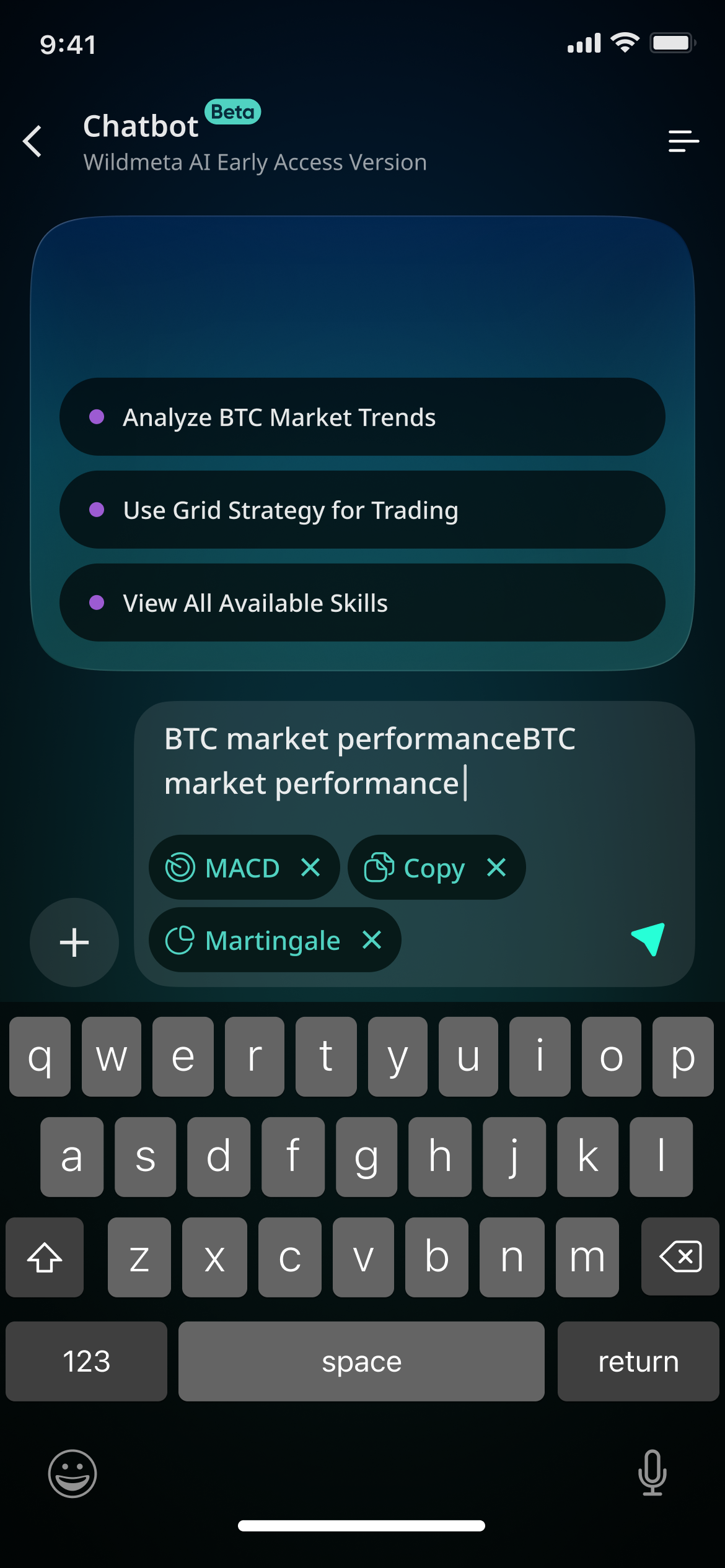
Wildmeta's trading copilot leverages a sophisticated LLM-based orchestration engine that serves as your personal trading assistant, capable of interpreting complex natural language instructions and coordinating multiple market operations seamlessly.
### Core Capabilities
The copilot interprets diverse trading intentions through natural language processing. Commands like "Create a market-making strategy on ETH-USDT," "Follow this trader's positions," or "Rebalance portfolio and put 50% of profit into HLP weekly" are automatically parsed, analyzed, and executed through appropriate skill combinations.
The system functions as a comprehensive trading companion, answering questions related to market analysis, position management, strategic planning, and autonomous trading operations. Unlike simple chatbots, the copilot maintains context across conversations, enabling sophisticated strategy refinement through iterative dialogue.
### Technical Infrastructure
Wildmeta deploys chatgpt-oss models on dedicated H100 GPU clusters, ensuring reliable performance and complete data privacy. This self-hosted approach eliminates dependencies on external API services while providing enterprise-grade computational resources for complex analysis tasks.
The infrastructure supports integration with alternative open-source foundational models including DeepSeek and Qwen, providing flexibility for specialized use cases or performance optimization. This modular approach enables rapid adoption of emerging LLM technologies without disrupting existing workflows.
### Integration with Skills Marketplace
The orchestration engine automatically connects with Model Control Protocol (MCP) providers to populate the agent with diverse capabilities. These skills transform the basic LLM into a powerful trading brain capable of market research, position analysis, strategic trading, and autonomous operations like copy trading.
Users maintain granular control over skill activation and blocking through preference settings. The copilot automatically manages skill payments through the x402 protocol, enabling seamless access to premium capabilities without manual transaction management.
### Autonomous Operation Framework
The copilot operates through a sophisticated autonomous payment system using dedicated x402 payment wallets. Users fund these wallets with USDC, enabling the AI to purchase skills and data services independently based on user requirements and budget constraints.
Service skills represent a particularly powerful category of autonomous capabilities. Once authorized by users, these skills can initiate and manage ongoing operations through the execution gateway. For example, activating copy trading service skills enables continuous monitoring of target traders' positions with automatic execution when changes occur.
Service skills implement standardized interfaces including start, stop, and status functions, enabling the copilot to manage complex operations autonomously while providing users with real-time visibility and control.
### User Experience Design
The copilot interface prioritizes intuitive interaction patterns that abstract technical complexity. Users communicate trading intentions in natural language without requiring knowledge of underlying protocols, skill marketplaces, or blockchain operations.
The system provides transparent cost estimates before executing paid operations, ensuring users maintain budget awareness and control. Historical logs track all autonomous payments and skill utilizations, enabling detailed analysis of strategy costs and effectiveness.
Advanced users can configure data provider preferences and skill cost thresholds through comprehensive settings interfaces. These configurations enable fine-tuned control over the copilot's behavior while maintaining the simplicity of natural language interaction for day-to-day operations.
# Execution Gateway
The execution gateway bridges the gap between AI analysis and on-chain action, enabling skills to execute trading decisions across multiple DEX platforms while maintaining precise economic alignment through sophisticated payment mechanisms.
### Execution Coordination
The gateway addresses fundamental challenges in autonomous trading where analysis and execution maintain complex, non-linear relationships. Unlike simple request-response patterns, trading scenarios often involve conditional or delayed executions based on evolving market conditions.
Position analysis skills might recommend maintaining current holdings without triggering any transactions, generating value through risk avoidance rather than action. Conversely, copy trading activation could generate multiple executions over extended periods as followed traders adjust their positions throughout different market cycles.
Multi-DEX connectivity ensures optimal execution across available liquidity sources while respecting user preferences for slippage tolerance, execution speed, and fee minimization. The system automatically routes orders through appropriate venues based on real-time liquidity analysis and historical performance metrics.
### Precise Fee Charging
Traditional x402 payments occur upfront, creating challenges for accurately pricing trading-related services where execution requirements cannot be predetermined. The gateway implements execution-based charging that aligns costs with actual value delivery rather than speculative pricing.
Skills can configure percentage-based charges tied to execution volume or fixed fees per transaction, enabling flexible monetization strategies that reflect true resource consumption. This approach ensures users pay for actual trading activity rather than potential actions that may never materialize.
Revenue sharing mechanisms enable skills to participate in execution success through performance-based compensation. Market-making strategies might charge higher fees during profitable periods while reducing costs during challenging market conditions, aligning provider incentives with user outcomes.
### Authorization Framework
The gateway requires explicit user authorization before executing on-chain operations, maintaining security while enabling autonomous functionality. Authorization lists stored on-chain specify which skills can perform operations for individual users, creating granular permission control.
Dual-signature verification ensures both user consent and skill authenticity for every execution request. User signatures confirm authorization for specific operations, while skill signatures verify the authenticity of execution requests from approved providers.
Smart contract validation occurs at the gateway level, verifying signatures and authorization status before processing any on-chain transactions. This architecture prevents unauthorized operations while maintaining efficiency for approved automated trading strategies.
### ERC-8004 Integration
The gateway implements ERC-8004 standard compliance for trustless agent operations, enabling reputation tracking and validation mechanisms that enhance security and trust within the autonomous trading ecosystem.
Skills must stake WILD tokens to participate in the execution gateway, creating economic incentives for proper behavior and accountability for trading decisions. Staking requirements scale with execution privileges, ensuring adequate skin-in-the-game for high-impact operations.
Governance-based slashing mechanisms provide recourse for skill misbehavior, enabling community enforcement of quality standards and user protection. The specific staking amounts and slashing conditions will be announced based on ecosystem development and community governance decisions.
### Service Skill Management
Service skills require specialized gateway support for ongoing operations that span multiple execution cycles. Copy trading services exemplify this requirement by maintaining continuous monitoring capabilities with sporadic execution needs based on target trader activity.
The gateway provides persistent session management for service skills, enabling long-running operations without repeated authorization overhead. Status monitoring ensures users maintain visibility into active services while preserving the ability to terminate operations at any time.
Conditional execution logic enables sophisticated automation where single service activation triggers complex, multi-step operations based on evolving market conditions. This capability makes the trading copilot significantly more autonomous compared to simple command-response interactions.
### Cross-Chain Capabilities
Multi-chain execution support enables seamless trading across different blockchain networks without manual asset management. The gateway coordinates cross-chain transfers and swaps as needed to execute trading strategies on optimal venues.
Automated asset bridging reduces friction for strategies that require positions across multiple networks while maintaining user control over cross-chain exposure and associated risks. Users can configure cross-chain preferences and limits to balance opportunity access with security considerations.
# HIP-3 and DEX abstraction
Wildmeta provides comprehensive support for HIP-3 DEXs, leveraging native abstraction capabilities inherited from Hyperliquid to enable seamless trading across multiple decentralized derivatives exchanges through unified interfaces.
### HIP-3
HIP-3 represents the openness of decentralized derivatives exchanges. Allow permissionless DEX deployment with underlying infrastructure of Hyperliquid.
Wildmeta fully support HIP-3 DEXs.
### Native DEX Abstraction
Wildmeta inherits Hyperliquid's DEX abstraction framework, enabling unified interaction with multiple HIP-3 platforms through standardized interfaces. This abstraction eliminates the complexity of managing different exchange APIs while maintaining access to platform-specific features.
**Unified Order Management** enables order placement and management across multiple exchanges through single interface commands. Traders can implement cross-exchange strategies without managing individual platform connections or order tracking systems.
### Supported Platforms
**Hyperliquid** serves as the primary HIP-3 platform with established liquidity and proven performance handling over $1 billion daily trading volume. Full integration provides access to all platform features including advanced order types and margin configurations.
# Charts and Indicators 1
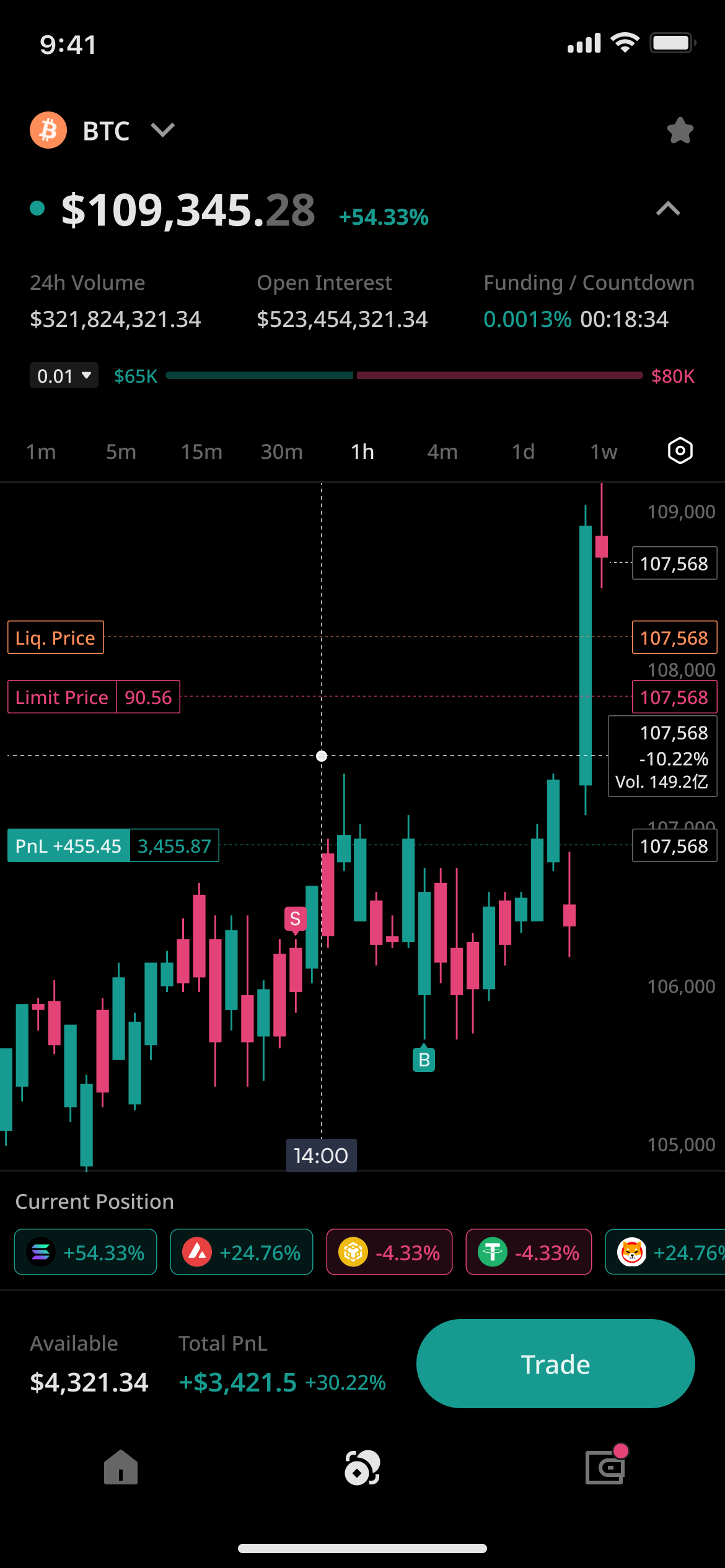
Wildmeta's trading terminal integrates professional-grade charting capabilities powered by TradingView, delivering institutional-quality technical analysis tools within a mobile-optimized interface designed for active perpetual derivatives trading.
### TradingView Integration
The platform leverages TradingView's comprehensive charting engine to provide advanced visualization capabilities typically found in desktop trading platforms. This integration ensures access to professional-grade analysis tools while maintaining mobile convenience and responsive performance.
Multi-timeframe analysis supports examination from minute-level charts for scalping strategies to weekly charts for long-term trend identification. Seamless switching between timeframes enables comprehensive market analysis without compromising mobile usability.
Real-time data streaming ensures accurate price action representation with minimal latency. Direct integration with Hyperliquid's data feeds provides tick-level accuracy for precise entry and exit timing in volatile market conditions.
### Technical Indicators
**Moving Averages (MA)** with 9-period close configuration provide trend identification and support/resistance levels. These indicators help identify market direction and potential reversal points for both manual trading and algorithmic strategy development.
**Exponential Moving Averages (EMA)** utilizing 9 and 26-period configurations offer responsive trend analysis with reduced lag compared to simple moving averages. EMA crossovers serve as popular signals for trend changes and momentum shifts.
**Bollinger Bands** deliver volatility analysis and potential reversal signals through dynamic support and resistance levels. These bands automatically adjust to market volatility, providing context for price action relative to statistical norms.
**Relative Strength Index (RSI)** with 14-period calculation identifies overbought and oversold conditions across different timeframes. RSI divergences often signal potential reversals before price action confirms directional changes.
**MACD (Moving Average Convergence Divergence)** utilizes 12-period, 26-period close, and 9-period signal line configuration for momentum analysis. MACD crossovers and histogram patterns provide early warning signals for trend changes and continuation patterns.
**Volume Analysis** displays default volume bars alongside price action to confirm trend strength and identify potential reversals. Volume patterns often precede price movements, providing additional confirmation for trading decisions.
### Chart Customization
Professional layout options enable traders to configure charts based on personal preferences and trading styles. Multiple chart types including candlesticks, line charts, and bar charts accommodate different analysis approaches and visual preferences.
Color customization allows optimization for different lighting conditions and personal preferences. Dark and light themes ensure comfortable viewing during extended trading sessions while maintaining chart readability.
Scale adjustment capabilities enable focus on specific price ranges or time periods for detailed analysis. Logarithmic and linear scaling options provide appropriate visualization for different market conditions and volatility levels.
### Integration with AI Copilot
Chart analysis integration enables the AI trading copilot to reference current technical indicators when providing strategy recommendations. This integration ensures AI suggestions consider current market conditions and technical setup quality.
Pattern recognition assistance helps identify classic chart patterns including triangles, head and shoulders, and flag formations. The copilot can explain pattern significance and suggest appropriate trading strategies based on pattern completion.
Indicator interpretation services provide educational context for technical analysis, explaining indicator readings and their implications for current market conditions. This feature benefits both novice and experienced traders seeking additional analysis perspectives.
### Performance Optimization
Mobile optimization ensures smooth chart performance across different device types and network conditions. Adaptive rendering adjusts chart complexity based on device capabilities while maintaining essential functionality.
Efficient data management minimizes bandwidth usage while ensuring accurate chart representation. Smart caching and data compression techniques enable professional-grade charting even with limited network connectivity.
Responsive design maintains chart readability and functionality across different screen sizes and orientations. Touch-optimized controls enable precise chart navigation and analysis on mobile devices.
### Advanced Features
Multi-symbol comparison enables correlation analysis between different trading pairs and market segments. This capability helps identify inter-market relationships and sector rotation patterns affecting individual positions.
Historical backtesting visualization allows examination of indicator performance across different market conditions. Users can evaluate indicator effectiveness for their specific trading strategies and timeframes.
# Margin Mode
Wildmeta's margin trading mode provides sophisticated leverage management through both isolated and cross-margin modes, enabling precise risk control while maximizing capital efficiency for perpetual derivatives trading on Hyperliquid.
### Margin Mode Selection
**Isolated Margin** restricts risk exposure to specific positions by allocating predetermined amounts of capital to individual trades. This approach prevents losses on one position from affecting other open positions, providing precise risk compartmentalization for diverse trading strategies.
Each isolated position maintains independent margin requirements and liquidation levels, enabling traders to implement different risk profiles across multiple positions simultaneously. High-risk experimental trades can coexist with conservative positions without cross-contamination of risk exposure.
Position-specific leverage settings allow optimization for different market conditions and confidence levels. Traders can utilize high leverage for high-conviction trades while maintaining conservative leverage for exploratory positions or uncertain market conditions.
**Cross Margin** utilizes the entire account balance as collateral for all positions, maximizing capital efficiency while creating shared risk exposure. This approach enables larger position sizes and reduces liquidation risk through portfolio-wide margin sharing.
Dynamic risk assessment considers correlation between positions when calculating overall account risk. Diversified portfolios benefit from reduced margin requirements compared to isolated positions, while concentrated positions face appropriate risk adjustments.
Automatic margin redistribution optimizes capital allocation across positions based on current market conditions and position performance. This system ensures optimal capital utilization while maintaining appropriate risk buffers.
### Leverage Management
Variable leverage settings accommodate different trading strategies and risk tolerances, with maximum leverage determined by position size, market volatility, and account history. Conservative traders can utilize lower leverage while experienced traders access higher multiples for appropriate strategies.
Real-time leverage monitoring displays current utilization across all positions with clear visualization of approaching risk thresholds. Color-coded warnings alert traders to increasing risk levels before reaching critical liquidation zones.
Automatic leverage adjustment capabilities enable position sizing optimization based on market volatility and correlation analysis. These systems help maintain consistent risk exposure as market conditions change throughout trading sessions.
### Risk Controls
**Liquidation Protection** implements multiple safety layers including early warning systems, automatic position reduction, and emergency closure mechanisms. These protections help prevent total position loss while maintaining trading flexibility.
Progressive liquidation algorithms reduce position sizes gradually as margin levels approach critical thresholds, preserving partial positions when possible rather than forcing complete liquidation. This approach minimizes losses while maintaining upside potential for position recovery.
**Stop-Loss Integration** enables automated risk management through predetermined exit levels for both individual positions and portfolio-wide exposure. These mechanisms execute without manual intervention, ensuring risk management continuity during all market conditions.
**Margin Call Systems** provide early warning notifications when account health deteriorates, enabling proactive position management before forced liquidations occur. Multiple notification channels ensure traders receive alerts regardless of their current activity status.
### Portfolio Health Monitoring
Comprehensive health metrics display real-time account status including available margin, utilized margin, and liquidation distances across all positions. These metrics enable informed decision-making about position sizing and risk management.
Stress testing capabilities simulate portfolio performance under various market scenarios, helping traders understand potential outcomes before they occur. Scenario analysis includes volatility spikes, correlation changes, and directional market moves.
Historical performance analysis tracks margin efficiency and risk-adjusted returns across different market conditions. This data helps optimize margin strategies and identify patterns for improved risk management.
### Integration with Trading Copilot
AI-powered risk analysis provides real-time assessment of current margin utilization and recommendations for optimal position sizing. The copilot considers market conditions, volatility patterns, and historical performance when suggesting leverage adjustments.
Automated rebalancing suggestions help maintain target risk levels as positions develop and market conditions change. These recommendations consider correlation changes and volatility adjustments that affect overall portfolio risk.
Emergency intervention capabilities enable the AI copilot to implement protective measures during extreme market conditions, including position reduction and risk limit adjustments based on predefined user preferences.
### Advanced Features
**Portfolio Margin** calculations consider correlations between different positions to provide more accurate risk assessment compared to simple position-based calculations. This approach enables more efficient capital utilization for diversified trading strategies.
**Dynamic Hedging** automatically adjusts hedge ratios and position sizes to maintain target risk levels as market conditions evolve. These systems help maintain consistent risk exposure regardless of market volatility changes.
# Trading Fees
Wildmeta implements a zero-fee trading model that eliminates traditional trading costs while generating revenue through value-added financial services, ensuring competitive execution without compromising platform sustainability.
### Zero Trading Fee Structure
Wildmeta charges no trading fees for any perpetual derivatives operations, eliminating one of the largest cost factors for active traders. This approach enables high-frequency strategies and reduces barriers for retail traders competing against institutional participants.
**No Builder Fees** ensures Wildmeta does not impose additional charges on top of exchange fees through builder codes or referral mechanisms. Users receive the same fee rates they would pay trading directly on supported exchanges.
All trading costs derive exclusively from underlying exchange fees, primarily Hyperliquid's fee structure for perpetual trading operations. This transparency ensures users understand exactly where their costs originate without hidden platform markups.
### Exchange Fee Pass-Through
**Hyperliquid Fee Structure** applies directly to all perpetual trading operations, with fees determined by trading volume tiers and maker/taker classifications. These fees reward liquidity provision while maintaining competitive rates for active traders.
Maker fees provide rebates for orders that add liquidity to the orderbook, encouraging market-making strategies and depth provision. Taker fees apply to orders that remove liquidity, reflecting the cost of immediate execution.
Volume-based fee tiers reward active traders with reduced rates as monthly trading volume increases. This structure aligns with professional trading requirements while providing incentives for platform loyalty and increased activity.
### Alternative Revenue Model
**Financial Services Revenue** derives from optional services including lending, cross-chain operations, and advanced portfolio management. These services provide additional value while maintaining zero trading fees for core functionality.
**AI Bot Deployment** charges fees for premium autonomous trading capabilities and specialized strategy access. Users can access basic trading functionality without fees while paying for advanced AI services that provide additional value.
**Cross-Chain Operations** generate revenue through spread capture on asset bridging and conversion services. These operations provide convenience value while enabling the platform to maintain zero trading fees.
### Cost Optimization Benefits
Zero trading fees enable previously unprofitable strategies including high-frequency market making and scalping operations. These strategies often require extremely low latency and minimal costs to remain viable in competitive markets.
**Enhanced Profitability** for active traders who previously faced significant fee burdens that reduced net returns. Elimination of trading fees directly improves strategy profitability without requiring performance optimization.
**Strategy Accessibility** opens sophisticated trading approaches to retail traders who previously could not overcome fee thresholds. High-frequency strategies become viable for smaller account sizes when trading costs are eliminated.
### Competitive Advantages
**Market Making Incentives** become significantly more attractive when trading fees are eliminated, encouraging liquidity provision and tighter spreads. This improvement benefits all platform users through enhanced execution quality.
**Volume Growth Potential** increases substantially when fee barriers are removed, enabling natural strategy scaling without cost concerns. Traders can implement position sizing based purely on risk management rather than fee optimization.
**User Acquisition** benefits from elimination of major cost barriers that often prevent traders from adopting new platforms. Zero fees remove primary objections while enabling fair comparison of platform features.
### Sustainability Framework
Revenue diversification ensures platform sustainability while maintaining zero trading fees long-term. Multiple revenue streams provide stability without requiring future fee implementation or service degradation.
**Token Economics** through $WILD buyback programs funded by financial services revenue create deflationary pressure while rewarding ecosystem participants. This model aligns token holder interests with platform growth.
**Value-Added Services** expansion provides growing revenue opportunities as the platform matures and user needs evolve. Premium services justify costs while maintaining free access to core trading functionality.
### Transparency and Trust
**Clear Cost Structure** ensures users understand exactly what they pay and why, building trust through transparency rather than hidden fees or complex pricing models. All costs are clearly attributable to external exchanges or optional services.
**No Future Fee Risk** protects users from unexpected cost increases that could disrupt established trading strategies. The zero-fee commitment provides certainty for long-term strategy development and implementation.
**Competitive Benchmarking** enables direct comparison with other platforms based on features and performance rather than complex fee calculations. This transparency benefits users while encouraging industry-wide fee competition.
# x402 Support and Extension
# Introduction
In this chapter we describe our extension of the x402 protocol (HTTP-402 payment required) mechanism by integrating with the EIP‑4337 / ERC‑4337 “Account Abstraction / UserOperation” framework, enabling signed user operations to be encoded in the `X-PAYMENT` HTTP header, forwarded through a TEE-backed facilitator for validation, simulation and on-chain settlement, and thereby delivering a flexible, multi-token, multi-chain payment flow for protected content access.
This extension (“x402 +4337”) offers a path to implement pay-walls and on-demand monetisation of HTTP content, APIs or any resource behind the standard HTTP 402 response, without the need for a dedicated token standard (e.g., ERC-3009) and with full flexibility of account abstraction, sponsored gas, arbitrary callData, and smart‐wallet verification logic.
We will walk through the conceptual background, the detailed flow, the architecture of facilitator and client SDK, features and advantages, and finally implementation and integration guidelines. within 30 days of first accepting these Terms.
15.5 **Governing Law**. These Terms shall be governed by German law, excluding conflict of law principles.
15.6 **Jurisdiction**. For disputes not subject to arbitration, the competent courts in Munich, Germany shall have jurisdiction.
***
### 16. GENERAL PROVISIONS
16.1 **Severability**. If any provision of these Terms is found unenforceable, the remaining provisions shall remain in full force and effect.
16.2 **No Waiver**. Failure to enforce any provision does not constitute a waiver of that provision.
16.3 **Assignment**. WildMeta may assign these Terms without notice. You may not assign these Terms without our written consent.
16.4 **Force Majeure**. WildMeta shall not be liable for any failure to perform due to circumstances beyond our reasonable control.
***
### 17. CONTACT INFORMATION
For questions about these Terms, please contact us:
**Trust Computing GmbH**
c/o HQ (3. Stock)
Feringastr. 6
85774 Unterföhring, Germany
Email:
Phone: +49 17684443881
Commercially registered at Amtsgericht Charlottenburg, Berlin, Germany: HRB\_222236\_B
VAT-ID: DE335594764
MSB Registration Number: 31000293020658
***
© 2025 Trust Computing GmbH. All rights reserved.
# Privacy
### **INTRODUCTION**
This Privacy Policy describes how Trust Computing GmbH ("WildMeta," "we," "us," or "our") collects, uses, and protects personal information when you use our WildMeta application, website, and related services (collectively, the "Services").
This Privacy Policy is incorporated into and forms part of our Terms of Service. By using the Services, you consent to the collection and use of your information as described in this Privacy Policy.
***
### **1. INFORMATION WE COLLECT**
#### **1.1 Information You Provide**
**WildMeta operates with minimal data collection. We only collect:**
**Optional Communication Data:**
* Messages sent through customer support (only if you contact us)
* Feedback and bug reports (only if you provide them)
**Note:** We do NOT require or collect:
* Email addresses for basic app usage
* Account registration information
* Personal identification documents
* Payment information
#### **1.2 Automatically Collected Information**
**Technical Data (Essential for App Functionality):**
* Device type and operating system version
* Browser type and version (for web version)
* IP address (temporary, for security purposes)
* App crash logs and error reports
* Basic usage analytics (anonymized)
**Camera Access (Only with User Consent):**
If you choose to use features that require camera access (such as QR code scanning for wallet connection or uploading a profile image), we will request permission. We do not access your camera without explicit consent and do not collect or store camera data without your action.
**Blockchain Data (Public Information Only):**
* Wallet addresses you connect to the Services
* Transaction data visible on public blockchains
* Smart contract interactions (public blockchain records)
**Important:** This blockchain data is already public and accessible to anyone. We do not make this information public - it already exists on public blockchains.
#### **1.3 Information We Do NOT Collect**
We explicitly do NOT collect:
* Your private keys or seed phrases
* Personal identification information
* Financial information beyond public blockchain data
* Location data beyond general IP geolocation
* Detailed browsing behavior or tracking data
* Social media information
* Contact lists or personal contacts
***
### **2. HOW WE USE YOUR INFORMATION**
#### **2.1 Service Provision**
* Provide and operate the Services
* Facilitate wallet connections and blockchain interactions
* Ensure app functionality and stability
* Provide technical support (only if you contact us)
#### **2.2 Service Improvement**
* Analyze app performance and stability
* Fix bugs and improve user experience
* Develop new features (based on anonymous usage data)
* Ensure security and prevent fraud
#### **2.3 Limited Communication**
* Respond to support requests (only if you contact us)
* Send critical security or service notifications
* Provide technical updates (if necessary)
**Note:** We do NOT use your information for:
* Marketing or promotional communications
* Selling data to third parties
* Detailed user profiling
* Targeted advertising
#### **2.4 Legal and Compliance**
* Comply with applicable laws and regulations
* Respond to legal requests (only when legally required)
* Protect the security and integrity of the Services
* Prevent fraud and abuse
***
### **3. BLOCKCHAIN TECHNOLOGY AND PRIVACY**
#### **3.1 Public Nature of Blockchain Data**
**Important Notice:** Blockchain transactions are public and permanent. Once recorded on a blockchain, transaction data cannot be altered or deleted. This includes:
* Wallet addresses
* Transaction amounts and recipients
* Smart contract interactions
* Timestamps and block information
#### **3.2 Non-Custodial Architecture**
WildMeta operates on a non-custodial basis, meaning:
* We do not store or control your private keys
* We do not have access to your funds
* We cannot reverse or modify blockchain transactions
* You maintain full control over your connected wallet
#### **3.3 Account Abstraction Technology**
Our use of ERC-4337 account abstraction technology:
* Enhances user experience while maintaining security
* Does not compromise your wallet's security
* Operates through your connected wallet's authorization
* Maintains the non-custodial nature of the Services
***
### **4. INFORMATION SHARING**
#### **4.1 Limited Service Providers**
We may share minimal technical information with:
* App hosting and infrastructure providers
* Error reporting and crash analytics services
* Essential security and fraud prevention services
**Important:** We do NOT share information with:
* Marketing companies
* Data brokers
* Social media platforms
* Advertising networks
#### **4.2 Legal Requirements**
We may disclose information only when legally required to:
* Comply with valid legal processes
* Protect against fraud or illegal activities
* Ensure user safety in emergency situations
#### **4.3 Business Transfers**
In the event of a merger, acquisition, or sale of assets, minimal information may be transferred to the new entity, subject to the same privacy protections.
#### **4.4 No Data Sales**
We do NOT sell, rent, or trade your personal information to third parties for any purpose.
***
### **5. DATA RETENTION**
#### **5.1 Retention Periods**
We retain personal information for as long as necessary to:
* Provide the Services to you
* Comply with legal obligations
* Resolve disputes and enforce agreements
* Achieve the purposes outlined in this Privacy Policy
#### **5.2 Blockchain Data**
Data recorded on blockchains is permanent and cannot be deleted. This includes:
* Transaction records
* Smart contract interactions
* Wallet addresses and balances
#### **5.3 Deletion Requests**
While we can delete information under our control, we cannot delete:
* Information stored on public blockchains
* Information retained by third-party service providers
* Information required to be retained by law
***
### **6. DATA SECURITY**
#### **6.1 Security Measures**
We implement appropriate technical and organizational measures to protect your information, including:
* Encryption of sensitive data
* Secure data transmission protocols
* Regular security audits and updates
* Access controls and authentication
#### **6.2 User Responsibility**
You are responsible for:
* Maintaining the security of your connected wallet
* Protecting your private keys and seed phrases
* Using secure devices and networks
* Reporting any security incidents
#### **6.3 Limitations**
While we strive to protect your information, no system is completely secure. We cannot guarantee absolute security of your data.
***
### **7. YOUR PRIVACY RIGHTS**
#### **7.1 EU/EEA Residents (GDPR Rights)**
If you are located in the EU/EEA, you have the right to:
* **Access:** Request a copy of your personal data (limited data we collect)
* **Rectification:** Correct inaccurate data
* **Erasure:** Request deletion of your data (subject to blockchain limitations)
* **Portability:** Receive your data in a portable format
* **Restriction:** Limit processing of your data
* **Objection:** Object to certain processing activities
* **Withdraw Consent:** Withdraw previously given consent
**Important Limitations:**
* We collect minimal data, so there may be limited information to access
* Data on public blockchains cannot be deleted
* Some technical data may be necessary for app functionality
#### **7.2 Other Jurisdictions**
Depending on your location, you may have additional rights under applicable privacy laws.
#### **7.3 Exercising Your Rights**
To exercise your privacy rights, please contact us at . Given our minimal data collection approach, we will respond to your request within the timeframe required by applicable law.
***
### **8. COOKIES AND TRACKING TECHNOLOGIES**
#### **8.1 Minimal Cookie Usage**
We use only essential cookies for:
* Basic app functionality
* Security features
* Error reporting
**We do NOT use cookies for:**
* User tracking across websites
* Advertising or marketing purposes
* Detailed behavior analysis
* Social media integration
#### **8.2 Third-Party Services**
We may use minimal third-party services that set cookies:
* Essential error reporting services
* Basic security services
#### **8.3 Cookie Management**
You can manage cookies through your browser settings. Note that disabling essential cookies may limit app functionality.
***
### **9. INTERNATIONAL DATA TRANSFERS**
#### **9.1 Data Processing Locations**
Your information may be processed in countries other than your own, including:
* Germany (our primary location)
* Other EU/EEA countries
* Countries with adequate data protection laws
#### **9.2 Transfer Safeguards**
When transferring data internationally, we implement appropriate safeguards such as:
* Standard Contractual Clauses
* Adequacy decisions
* Other legally recognized transfer mechanisms
***
### **10. CHILDREN'S PRIVACY**
#### **10.1 Age Restrictions**
The Services are not intended for individuals under 18 years of age. We do not knowingly collect personal information from children.
#### **10.2 Parental Notice**
If you believe we have collected information from a child, please contact us immediately so we can delete such information.
***
### **11. THIRD-PARTY SERVICES**
#### **11.1 Third-Party Links**
The Services may contain links to third-party websites or services. This Privacy Policy does not apply to such third-party services.
#### **11.2 Third-Party Responsibility**
We are not responsible for the privacy practices of third-party services. Please review their privacy policies before using their services.
***
### **12. CHANGES TO THIS PRIVACY POLICY**
#### **12.1 Updates**
We may update this Privacy Policy from time to time. Material changes will be communicated through:
* Email notifications
* In-app notifications
* Website announcements
#### **12.2 Continued Use**
Your continued use of the Services after changes take effect constitutes acceptance of the updated Privacy Policy.
***
### **13. CONTACT INFORMATION**
#### **13.1 Privacy Questions**
For questions about this Privacy Policy or our privacy practices, please contact us:
**Trust Computing GmbH**
c/o HQ (3. Stock)
Feringastr. 6
85774 Unterföhring, Germany
Email:
Phone: +49 17684443881
#### **13.2 Data Protection Officer**
For EU/EEA residents, you may contact our Data Protection Officer at:
#### **13.3 Supervisory Authority**
EU/EEA residents have the right to lodge a complaint with their local supervisory authority if they believe we have violated their privacy rights.
***
### **14. LEGAL BASIS FOR PROCESSING (EU/EEA)**
We process your personal information based on the following legal bases:
* **Contract Performance:** To provide the Services you've requested
* **Legitimate Interests:** To improve our Services and ensure security
* **Legal Obligation:** To comply with applicable laws and regulations
* **Consent:** For marketing communications and optional features
***
© 2025 Trust Computing GmbH. All rights reserved.
# Account Deletion Policy
At **Wildmeta**, we prioritize the privacy and security of our users. This document outlines the procedures and timelines related to the deletion of user accounts and associated data.
### **1. Account Deletion Request**
Users have the ability to delete their **Wildmeta** account at any time. To initiate the deletion process, users must submit a request via the platform interface. Once the request is submitted, we will proceed with the account deletion.
Wildmeta is a non-custodial platform and does not require KYC (Know Your Customer) verification. As such, users are solely responsible for managing their accounts and associated private keys.
### **2. Data Deletion Scope**
Upon account deletion, the following user data will be permanently erased:
* Account information (username, email, connected wallet address, and any other identifying information)
* Transaction history
* User preferences
* Any other personal data stored in our database related to the account
Please note that because **Wildmeta** does not require Know Your Customer (KYC) verification, no personally identifiable information (PII) beyond what is collected through our platform will be retained or stored.
### **3. Legal and Compliance Obligations**
In certain situations, data retention may be required by law for regulatory purposes. If **Wildmeta** is obligated to retain data to comply with legal or regulatory requirements, we will retain the necessary data for the specified duration before it is permanently deleted.
### **4. Data Security**
Since **Wildmeta** does not collect or store any user data, there is no centralized repository of information that could be vulnerable to breaches or unauthorized access. Users are responsible for safeguarding their own private keys and managing their digital assets securely.
### **5. Final Considerations**
Once the account and data are deleted, they cannot be recovered.
We encourage users to back up any necessary information before proceeding with account deletion.
By using the **Wildmeta** platform, you acknowledge and agree to the terms of this account deletion and data retention policy.
### **6. Timeline for Deletion**
Upon receiving a valid account deletion request, we will proceed with the following timeline:
* **Account Deletion Process Initiation:** We will initiate the deletion process within 7 business days of receiving the request.
* **Data Deletion:** All personal data associated with the account, including transaction history, account details, and any other identifiable information, will be deleted within 30 days of the request.
Please note that certain data may be retained for a longer period if required by applicable laws or for legitimate business purposes, such as complying with anti-money laundering (AML). This retention will only apply to the extent necessary and will be limited to the minimum required by law.
### **7. User Rights**
Users have the right to:
* **Request Deletion:** Users can request account deletion at any time by contacting us.
* **Data Access:** Users may request access to their personal data before deletion by contacting our support team.
* **Rectification:** Users can request corrections to their personal data if any information is inaccurate or incomplete.
### **8. Policy Updates**
**Wildmeta** reserves the right to amend this policy. Continued use of the platform constitutes acceptance of revised terms.
**Contact Us:** If you have any questions or concerns about this Policy or our data deletion practices, please contact us here:
***
## **Account Cancellation Process**
1. **Go to Profile:** Click on the avatar at the top right corner to enter your personal profile page. 
2. **Enter Account Settings:** Scroll down and select **Account Setting**. 
3. **Choose Delete Account:** In the **Account Setting** page, tap on **Delete Account**. 
4. **Confirm Deletion:** On the confirmation screen, click **Delete Account** again to continue. 
5. **Final Confirmation:** A pop-up window will appear. Select **Delete Account** to permanently delete your account, or **Cancel** to abort.